
Kazakhstan's $4.85 Billion Investment Drive at COP28
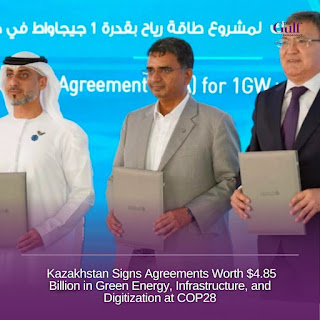


At the COP28 climate summit in Dubai, Kazakhstan signed 20 agreements with international partners, totaling $4.85 billion.  These agreements focus on green energy, infrastructure, and digitization, highlighting Kazakhstan's commitment to sustainable development and its goal of achieving carbon neutrality by 2060.  


A significant portion of the investment is directed towards renewable energy projects.  Notably, the UAE's Masdar will lead the construction of a 1 GW wind power station in northern Kazakhstan, a project valued at $1.4 billion.  Additionally, France's TotalEnergies plans to develop a 1 GW wind farm in the Zhambyl region, incorporating a 600 MWh battery storage system to ensure a stable power supply.  


Furthering its renewable energy initiatives, Kazakhstan's Samruk-Kazyna Sovereign Wealth Fund has partnered with Saudi Arabia's ACWA Power to develop a 1 GW wind power project in the Zhetysu region, which will include an energy storage system.  These projects collectively aim to add 3 GW of wind energy capacity to Kazakhstan's power grid.  


Beyond energy, Kazakhstan is enhancing its infrastructure and digital capabilities.  Kazakhstan Temir Zholy, the national railway company, and Abu Dhabi Ports Group have agreed to collaborate on maritime transportation, port development, railway logistics, digitization, and trade.  This partnership aims to transform the ports of Aktau and Kuryk into leading maritime hubs on the Caspian Sea.  


In the realm of digitization, Samruk-Kazyna and Presight.AI plan to establish a joint venture to implement big data analytics solutions across various sectors, including energy, public services, and transport.  They also intend to explore the development of high-performance computing capacity and enterprise AI solutions in Kazakhstan.  


These comprehensive agreements underscore Kazakhstan's strategic approach to sustainable development, combining renewable energy expansion with infrastructure modernization and digital transformation.  By fostering international collaborations, Kazakhstan is positioning itself as a proactive player in addressing global climate challenges and advancing its economic growth.

Comments

Popular posts from this blog

Sky Care: How the UAE’s First Hospital Vertiport is Redefining Emergency Response

  Imagine a critical patient, a time-sensitive organ for transplant, or a specialist medical team needed across a bustling city. On the ground, traffic is a formidable adversary, where every minute lost can alter outcomes. Now, imagine that same journey taking minutes instead of an hour, not by navigating the roads, but by soaring gracefully above them. This is not a scene from a sci-fi film; it is the new reality in the United Arab Emirates. In a landmark move that solidifies its position on the global stage of innovation, the UAE has officially launched the nation’s — and the region’s — first hospital-based vertiport at Cleveland Clinic Abu Dhabi. This isn’t just a helipad with a new name. It is the cornerstone of a fully integrated, city-wide advanced air mobility (AAM) ecosystem, marking a profound convergence of cutting-edge aviation, AI-driven healthcare, and sustainable infrastructure. The Launch of a Lifesaving Corridor The project is a powerful collaboration between aviati...

Three Houses, One Vision – How the UAE’s Abrahamic Family House is Redefining Inter-Faith Dialogue

  When you step onto the stone-plinth of the Abrahamic Family House on Saadiyat Island in Abu Dhabi, you are not just visiting a building. You are entering a bold statement: a mosque, a church and a synagogue standing side-by-side, equal in size and purpose, sharing common ground while respecting their separate faiths. A landmark of coexistence In early 2023 the UAE inaugurated this pioneering complex, inviting worshippers and visitors alike. The architecture — designed to give each of the three faith-homes the same external dimensions and to signal equality — allows each to express its own traditions while remaining visibly part of a unified vision. More than 200 nationalities live in the UAE, which means the project reflects a multicultural reality in which multiple faiths and identities coexist daily. Islam’s role in the vision For Muslim-majority audiences in the Gulf, the Abrahamic Family House sends a resonant message: Islam does not fear dialogue — it embraces it. The m...

Beyond the Barrel: The UAE's Steady Hand in a Shifting Global Economy

  Global economic rankings often highlight familiar names, but a steady, deliberate climb is happening in the Gulf. The UAE consistently ranks as one of the most economically stable nations, and this validation stems from a steady reform model that has successfully insulated its economy. The story is no longer about oil wealth; it's about the strategic deployment of that wealth to build a resilient, modern, and dynamic knowledge economy. The proof is in the sectors now driving growth.  Tech startups  are flourishing in Dubai and Abu Dhabi, supported by government venture funds and a growing pool of talent.  Smart cities  like Masdar City and NEOM are not just futuristic concepts but active testbeds for sustainable living and business. This has triggered record  FDI inflows , with the UAE securing its position as the 16th largest global destination for foreign direct investment. The narrative is supported by hard data: a GDP growth projection of 4.6% in 2025...